Featured

Managing with Insecticides

Written by: Kim White
Edited by: Alex Fleming
Diamondback moths can cause millions of dollars in damage if left unmanaged. In Canada, the diamondback moth affects crops in Eastern Alberta, Saskatchewan and Manitoba. The moths arrive from the South by wind in May and can survive up until the cold prairie winters. Managing for diamondback moths is necessary to prevent serious damage to crops and limit the impact on the economy. The severity of impact varies year to year however, with management we can reduce the risk. 

            Monitoring for diamondback moths is the first and most critical management tactic. Understanding the approximate population at the beginning of the season can help with determining how the pest needs to be further managed. Fortunately, there are some biological management tactics that have been discussed and can be just what is needed. However, if the pest becomes more severe then further action must be taken by using insecticides. Insecticides can be applied with either aerial or ground equipment. The application of the insecticide is most effective when populations are at their larval stages. Effectiveness is reduced for adults, pupae and eggs. Insecticides can kill adult diamondback moths however, because they lay eggs within 24 hours of becoming an adult, this would have little effect on controlling the pest. 

            The table below lists the products that can be applied to control the diamondback population. It is important to take note of the pre-harvest interval (PHI) because it varies with each product and it is illegal to harvest before the PHI. The following table is a list that the Government of Manitoba provides of the insecticides used for diamondback moths, the pre-harvest intervals and the amount needed per acre. Applying insecticides on flowering crops is not recommended due to the risk of harming honeybees and other pollinating insects. Therefore, if insecticide must be applied to flowering crops, it should be done in the evening.

ProductRate of product per acrePreharvest Intervals (days)
  CanolaMustard
Coragen51 ml11
Decis 5EC40-60 ml77
Poleci81-121 ml77
Matador/Silencer34 ml77
Voliam Xpress91 ml77
Lorsban/Pyrinex/Nufos/ Citadel405-607 ml21
Malathion 500220-340 ml7
Malathion 85E105-168 ml77

Table 1 https://www.gov.mb.ca/agriculture/crops/insects/diamondback-moth.html

Chemical reliance for controlling diamondback moth populations has resulted in the pest developing a resistance to some insecticides. In Australia, there has been evidence of resistance to synthetic pyrethroid insecticides which adds to the challenges of controlling diamondback moths. 

            Another method is adjusting the amount of fertilizer in the soil. The diamondback moth prefers the amount that is recommended for the crops, however, studies have shown that either not using fertilizer or using 3-5 times the proper amount is beneficial for management. Sulfur-fertilizer seems to have the greatest influence on the diamondback moth, females tend to lay their eggs where there is a higher sulfur content compared to soil that is sulfur deficient. 

            Some other methods of management are starting crops with clean and healthy transplants, checking brassica crops weekly during the summer months, plough crop residues or heavily infested crops promptly, and understanding the life cycle of the moth and recognizing the larval stage. Pre-seeding weed control and preparing the land reduces the availability of cruciferous weeds and volunteer canola host plants, preventing the first generation of larvae to be established. 

One option that is still being tested is the use of synthetic sex pheromones. They are used as a mating disruption and so far have proven to be effective when mixed with other, more traditional control methods. The greatest benefits of using this method is the reduction to Diamondback Moth populations without affecting the populations of predators and parasitoids. Two studies, one done in Japan in 1986 and the other in China in 2008-09 have proven it’s effectiveness. In both cases there were three groups of fields: one control, one using traditional pesticides, and one using pesticide and mating disruption. 

The control group was so badly damaged that no numbers could be recorded of adult males or of the eggs and larvae that settled there. As for the other fields, adult males were shown to remain at roughly the same density between both the insecticide field and the insecticide+pheromone field. The fields using pheromones did have less adult males overall but the difference was to small to be considered significant for the case of the study.

However the number on eggs and larva found on the plants did change significantly with the use of pheromones. In the Japanese study there were 3 or more larvae/pupae found per plant after a month of observation. In comparison, the fields sprayed with the insecticide+pheromone mixture had an average of 2 per plant recorded in one month before showing signs of declining.

When the study was done in China there were other factors being tested for, namely the amount of dispensers used per hectare and which had the greater impact. It was found that too much of the pheromone was counter productive, having little to no impact. The greatest effect on the Diamondback Moth was when using 167 polyethylene ‘rope’ dispensers per hectare. This produced very similar results to the study conducted in Japan, further proving the strength of using pheromones as a control measure. These studies show that pheromones can reduce populations by up to 50% when compared to traditional-practices.

This method does have it’s own drawbacks and still requires testing to see just how effective it is. Setting up a large number of dispensers, or spraying multiple times, gets expensive. While less sprays are required before seeing significant changes to the Diamondback Moth populations it does nothing to prevent other pests from coming in and devouring the same plants that we are trying to protect. There is also a chance that, due to the nature of studies done so far, not all of the success can be given to the use of pheromones alone. In both cases there were predators and parasitoids found within the fields that could have contributed to the reduced populations and neither study had any way of accounting for their presence.

            Diamondback moths have the potential to cause a lot of damage. Fortunately there are options to manage for the pest and if there is consistent monitoring and management, the risk of damaged crops is largely reduced. 

Resources:

https://www.gov.mb.ca/agriculture/crops/insects/diamondback-moth.html

https://onlinelibrary.wiley.com/doi/full/10.1111/j.1744-7917.2011.01497.x
Lifecycle of the Diamondback Moth

Written By: Joseph Manes
Editor: Kim White

The diamondback moth goes through complete metamorphosis, meaning they have distinct egg, larval, pupal and adult life stages. This complete cycle from egg to adult varies and through each stage is dependent on the temperature. The average development time is between 21 – 51 days with the warmer southern parts where diamondback moths are found being quicker than the colder northern parts. With the cold weather found in northern climates the mortality of the diamondback moth is quite high, curtailing the population. Throughout the year the diamondback moth goes through four to five generations of which generally overlap between the generations. Due to this each stage of the life cycle, from egg to adult can be found simultaneously. During mating season, the female can lay between 200 – 300 eggs, with an average of about 150 in their life span of about 16 days. The laying of the eggs can be quite quick when given a readily available host. As larvae they have a distinct reaction to being disturbed, they wiggle backwards and drop from the plant, dangling by a silk thread, of which after several seconds they will climb back on top of the leaf to continue eating.

Egg:  The eggs of the diamondback moth are mostly laid on concavities of the leaves avoiding the smooth surfaces. These eggs are glued to the upper and lower parts of the hosts leaves with the underside being preferable due to the protection from direct sunlight. Eggs are oval in shape, tiny, and have a yellowish-white color to them. Depending on the environmental conditions present the eggs take anywhere from four to eight days to hatch into the subsequent larval stage.

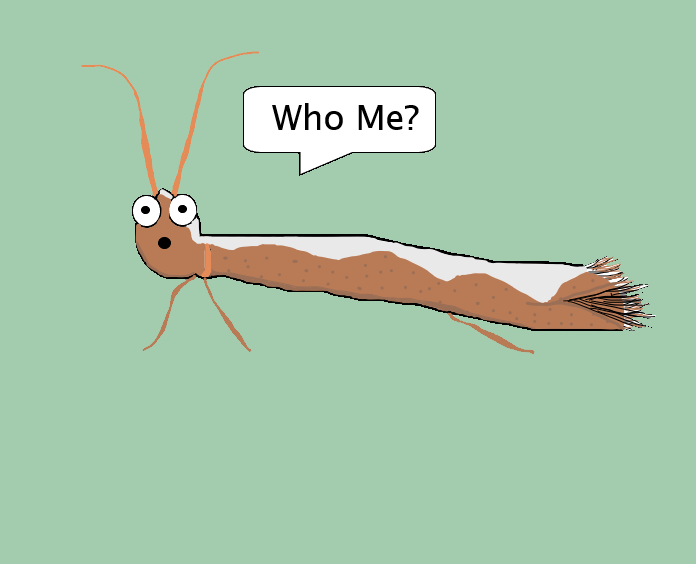
Larvae: Once the eggs have hatched into larvae they begin to immediately burrow into the leaf, eating the host plants leaf tissue, the mesophyll. The larvae will molt three times, with these subsequent instar stages feeding on the surface of the leaves, buds, flowers and pods. This stage can last between ten to 21 days, with this varying depending upon the given temperature and food availability. These larvae are yellowish green to green which are covered with fine, scattered hairs and have a forked end. At maturity these larvae measure in at about 12mm and are cigar in shape. After the last instar stage, the larvae begin to construct a cocoon to begin the pupal stage.

Pupal: The cocoons that were made at the end of the pupal stage are attached to the leaves, stems or seed pods of the host plant. They are white open meshed, and delicate, with development being finished between five to 15 days. As the pupal develops the turn from a light green to a brown as they mature into the adult moth.

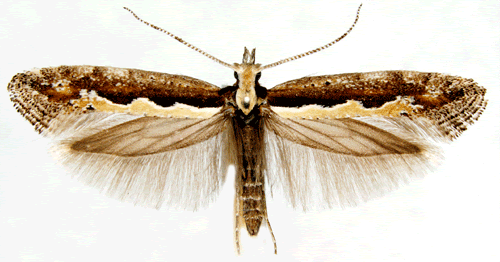
Adult: The moth that emerges from the pupal stage is about 8 to 9mm long and has a wingspan of about 12 to 15mm. Their wings fold over the abdomen, flared upward and outward toward fringed, long haired tips. Yellow wavy markings on the forewings at rest come together to form three diamonds, giving the moth its name. These are short lived and typically feed on dew and water droplets, finishing off the life cycle. 

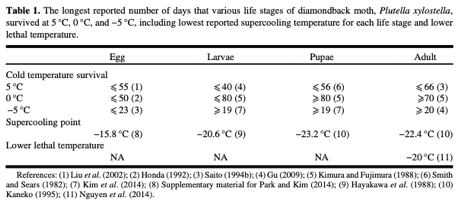
Overwintering and effects of climate change: Temperature is a major factor in the success of diamondback moths. Development of instars occur more slowly at when temperatures are lower (between 4-6 degrees Celsius). Survivorship decreases significantly at 0 degrees Celsius. The fourth instar has proven to be the most successful during cold conditions out of all the instars.

Image: https://search-proquest-com.ezproxy.viu.ca/docview/2011572569/fulltextPDF/CC2CDC152EA40D8PQ/1?accountid=12246

There is some discrepancy about when or if overwintering occurs. Historically, it was thought to occur during the pupal stage. A study done by Harcourt and Butts found that pupae survived for 30 days with temperatures around 0 degrees which followed by health adults emerging. However, after 40 days, the adults that emerged died shortly after. It has also been proposed that overwintering occurs in the adult stage and there was more survival at temperatures around -5 degrees Celsius. Diamondback moths do not overwinter in diapause but rather they survive unfavorable conditions in quiescence. It is more common that diamondback moths travel North from warmer, more southern regions when temperatures are more favorable and there is an increase in food sources. 

Climate is changing and with that comes the concern of increased pests in crops. Diamondback moths do not do well when it is very cold but have been able to survive mild winters. With climate changing and temperatures rising, this could become a concern. However, at this point in time, it does not seem to be a significant issue because where these crops are, winters still get cold enough for long enough to keep the moths at bay. Furthermore, there needs to be more research and studies done to know exactly if or how the diamondback moth will progress as the climate continues to change. 

Sources: https://search-proquest-com.ezproxy.viu.ca/docview/2011572569/fulltextPDF/CC2CDC152EA40D8PQ/1?accountid=12246

How Does Nature Fight Back?!

Written by: Alex Fleming
Edited by: Nathan Waatainen

Parasitoids: The strongest natural defence mechanism (including the Diadegma Wasp) can’t keep up

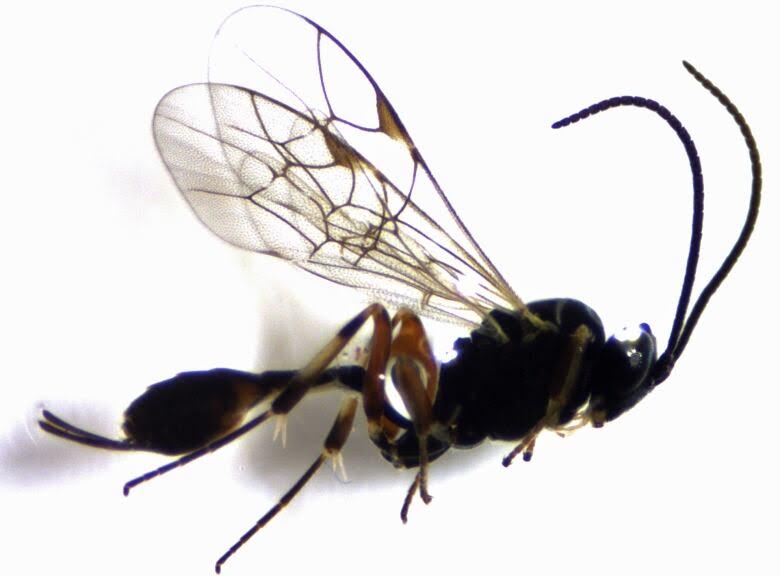
           Management of pest populations (such as the Diamondback Moth) requires a multifaceted approach that typically will involve introducing or promoting a natural parasitoid to attack the pest of interest. A parasitoid is an organism that survives by living in a parasitic relationship with another parasite, often times in the process killing the parasitized parasite. In healthy ecosystems parasitoids naturally exist as a type of population control mechanism, ensuring a relatively stable population of parasites. The Diadegma Wasp (Diadegma insulare) is the most effective fighter against the Diamondback Moth. While they do not kill the Diamondback Moth outright, they are still effective at protecting against the moths defoliating. The wasp can parasitize up to 90% of a generation and, while parasitized, the larvae of the Diamondback Moth only eats 20% of its usual diet. The parasitized larvae also never reach sexual maturity meaning the wasp can nullify the Diamondback Moths presence on a large scale. To do this the female lays her eggs within a larva of the moth wherein her babies will hatch and grow within the moth larvae. The wasp larvae do not kill the moth larvae, rather feeding off it slowly. The wasp larvae wait for the moth to create their cocoon and once completed, finishes feeding off its host and creates a secondary cocoon within the moths’ cocoon. A complicated but effective survival strategy. 

Unfortunately our bio control efforts are being hindered due to the Diadegma Wasp being slowly pushed out of the areas where Diamondback Moth is found. As the moth feeds off our crops we fight back with our own pesticides. The moths themselves have slowly built up a resistance to many of the pesticides used, which the wasp has not been able to achieve under this time period. When a wasp reaches adulthood and gets a chance to infest a host it is generally eventually killed by the pesticide contaminating the moths’ body. Until pesticide use outdoors is reduced or the wasp species grows a tolerance to the pesticide there will be ongoing issues related to biocontrol implementation.

A potentially important parasitoid species that is also being damaged by insecticides is Oomyzus sokolowskii. This Diamondback Moth killing species was found to suffer a 91% mortality rate when exposed to cabbage leaf which was dipped in insecticide in a study conducted in the South-Eastern United States by Roberto J.Cordero, Jeffrey R.Bloomquist, and Thomas P.Kuhar for Biological Control Vol. 42. This study’s result indicates that if we hope to manage the DBM effectively we must consider the consequences of trying to use two different pest control methodologies simultaneously.

Predators: The ‘second ringers’ are now our first defence

The Diamondback Moth has many other predators, although none of them hunt the moth with the same drive and need as the Diadegma Wasp. This moth native to Europe, but found in many other continents is able to lay hundreds of eggs in its 25 day life span. One weakness of this wasp is that they do not hunt for the fully-developed moths, instead subsisting on moth eggs and larvae. It’s not fully understood how effective these predators are at fighting back against the Diamondback Moth from a management standpoint, but it is estimated that they regularly kill 90% of the first instar larvae.

To better understand the wasp’s effect on the moths’ population, a study was done by Freddy Miranda and colleagues for the 40th edition of Environmental Entomology. This study was conducted within several cabbage fields in Nicaragua for the purpose of trying to identify the most common and most effective predators to the Diamondback Moth found locally. The full list of species as follows was divided between the classification of spiders and insects:

SpiderInsect
Sac Spiders (Clubionidae)Rove Beetles (Staphylinidae)
Ground Spiders (Gnaphosidae)Earwigs (Forficulidae)
Wolf Spiders (Lycosidae)Hover Flies (Syrphidae)
Sheet Weavers (Linyphiidae)Toad Bugs (Gelastocoridae)
Jumping Spiders (Salticidae)Damsel Bugs (Nabidae)
Long-jawed Orb Weavers (Tetragnathidae)Assassin Bugs (Reduviidae)
Crab Spiders (Thomisidae)Eusocial Wasps (Vespidae)
Harvestmen (Phalangiidae) 

Of these candidates the most common species from each list was the Wolf Spider, making up 37% of all spiders found, and the Rove Beetle at 54% of all insects collected. Once this information was drawn, several tests were undertaken to find out which of these species were the most significant eaters of the Diamondback Moths eggs and larvae.

Each species was trapped and secluded before being starved for 24hrs as a measure to ensure that a uniform hunger would be accounted for. Next they were offered eggs, as well second and third instars of the moth and were fed for up to 13 days or until the predator died. Of the species found eating eggs, no spiders were recorded, however, there were two clear successors among the insects: Rove Beetles and Damsel Bugs. The second and third instar larvae were primarily consumed by the spiders.  The study found the most successful of the spiders were: Sheet Weavers, Wolf Spiders, Jumping Spiders, Crab Spiders, and Long-Jaw Orb Weavers. The larvae inclined insects were: Rove Beetles, Hover Flies, Damsel Bugs, and Assassin Bugs.

While more tests are required before anything definitive can be said of the efficacy of using parasitoids of the Diamondback Moth in agriculture on an industrial scale, the early reports show that there is hope. Researchers now have a narrower scope of insects and spiders that should be investigated. Parasitoids may likely soon be very helpful on an industrial scale in fighting back against the moths’ destruction of our cruciferous crops worldwide.  

Parasitoids: Are they a realistic consideration in DBM management?

           Utilizing parasitoids in management of pests on food crops is typically very difficult, largely due to continuous need for improvements, research and monitoring. While there are parasitoids which have worked to keep the Diamondback Moth populations in check in the past, most are no longer effective. Many have become next to useless when it comes to the Diamondback Moth management due to natural adaptation because of past usage as an active ingredient in pesticides. As the moth has developed a greater resistance to the pesticides used on fields everywhere it has also overcome the effects of most pathogens that target insects.

It’s important to note that there are three possible exceptions to this pattern: Bassi (Beauveria bassiana), Mechinikov (Metarhizium anisopliae), and Wize (Paecilomyces fumosoroseus) which are all funguses that have proven to be effective against the Diamondback Moth. There is still not enough research data to justify their use in any large-scale capacity either but they have quickly become the next major research and development focus.

Nature has been an effective manager of the Diamondback Moth population in the past. Without an exterior influence it is likely that this statement could apply for today and in the future. 

Diamondback Moth caterpillar encased in Bassi Fungi

 Sources:

https://academic.oup.com/jipm/article/5/3/D1/2194296?fbclid=IwAR2BjL6c8FIUJEEpALKm9M3-ibh_rIw8Pi2Eh0Tb0OAw2k69R-IRk5BfDIw

https://academic.oup.com/ee/article/40/2/333/412166

https://www.sciencedirect.com/science/article/abs/pii/S1049964407000904

https://www.pestnet.org/fact_sheets/biocontrols__diadegma_285.htm

https://www.shutterstock.com/image-photo/infection-beauveria-bassiana-insects-zombie-on-169231043

Diamondback Moth and its Effects on Crops


Written by: Nathan Waatainen
Edited by: Joseph Manes

Introduced species have a long history of wreaking havoc upon natural ecosystems and man-made crops alike. The primary issue with introduced species is that they don’t have a defined role in the food cycle so there usually cannot be ecological balance without some form of correction. This correction usually leads to the introduced species carving its own role, often times causing the entire ecosystem balance to be ruined. The lack of ability to adapt to the pest and not having any natural predators or defenses ensures of a fate of crop destruction. A stark example of how serious this problem can be to us would be the effects Diamondback Moth are having on a variety of important crops worldwide, sometimes leading to large shortages or price fluctuations.

The Diamondback Moth (Plutella xylostella) is limited to feeding on plants in the Brassicaceae family, or more commonly known as the mustard family. This family includes many plants such as; canola, mustard, cabbage, cauliflower, broccoli, and kale. This family of plants are easily defined by having a sulfur – containing plants parts called glucosinolates, which are toxic to most insects, but the Diamondback Moth are known to rely on some of these plants parts for things like host detection, oviposition and breaking down the plant for food. Compounds in this family of plants, as well as toxic residues waxes, and factors that include the host plant nutrition quality, leaf morphology and leaf colour, or a mix of these, can possibly trigger behavioral changes to reproductive and feeding behavior of insects, including the Diamondback[n1] Moth. This is a major problem for farmers that use crops in this plant family, not only locally in Canada, but also internationally where large groups of farmers are effected. Though the pest was introduced in about 150 years ago it wasn’t a significant problem in North America until the 1950’s when their population grew. Through increased tolerance to insecticides, and the insecticides relative ineffectiveness the Diamondback Moth was deemed out of control in the 1980s. Alternative measure and a stronger focus was placed on parasitoids as a means of management. Known parasitoid that effects this species of moth comes from Western Canada, were parasitic wasp attack the moth, with the most noticeable being the Diadegma insulare, and the Microplitis plutellae. These two species of was often attack the Diamondback moth when it is in its larval stages. There is also a parstic wasp which often attacks in the pupal stages that being the Diadromus subtilicornis.

The host plants must certain conditions for the Diamondback Moth to most likely attack and be successful in doing so. This is especially important in Canola and Mustard Weed. The moth will does not usually target crops in the first stage of plant development, but will target as in the later stages. There are situations where they are likely to attack earlier. This often isn’t a good thing for the current crop due to the increased time for the Diamondback moth reproductive life cycle to take place, up to a maximum of 4, leading to a possible peak year. It is often the case that populations of the moth are hard to predict on previous year population. This is mostly attributed to Canadians cold harsh winters where very few if any of the pupae survive. This leads to variability of the severity year to year being dependent on factors in the south and winds that may transport the moths up to northern parts.

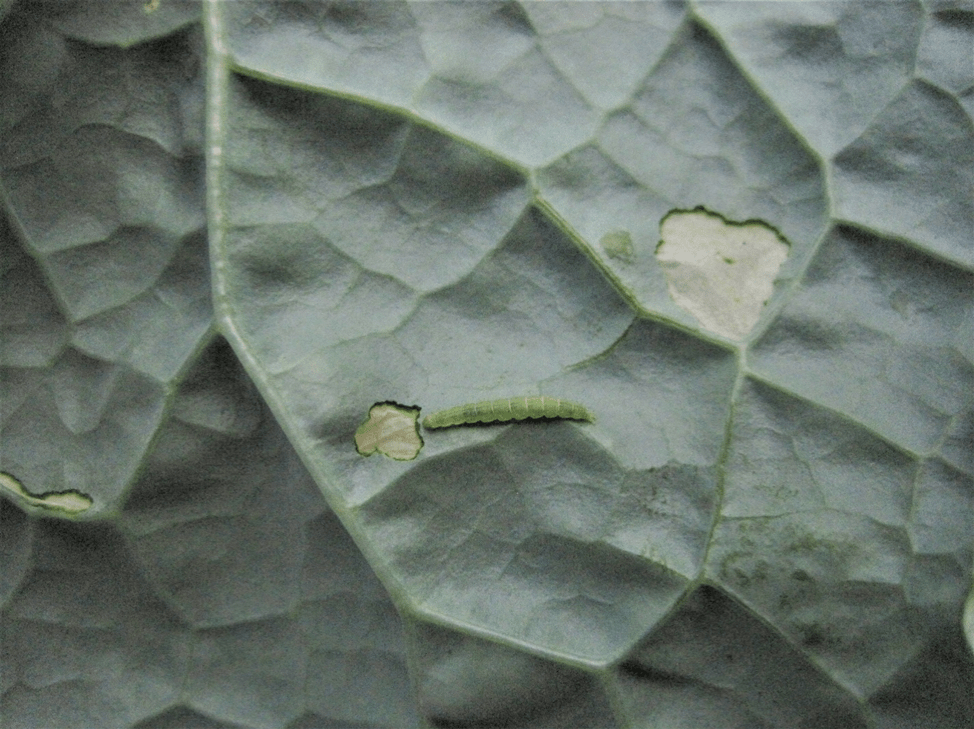
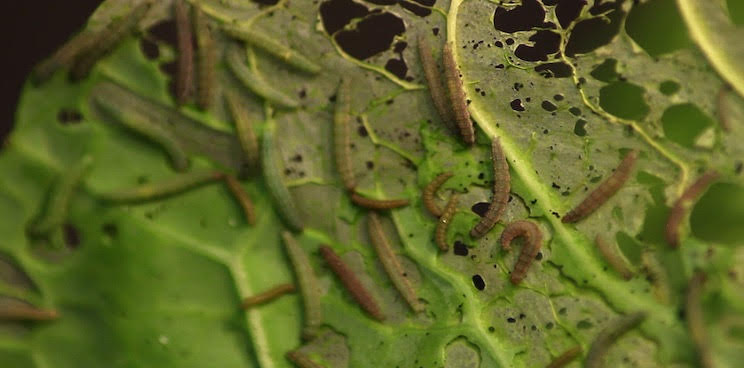
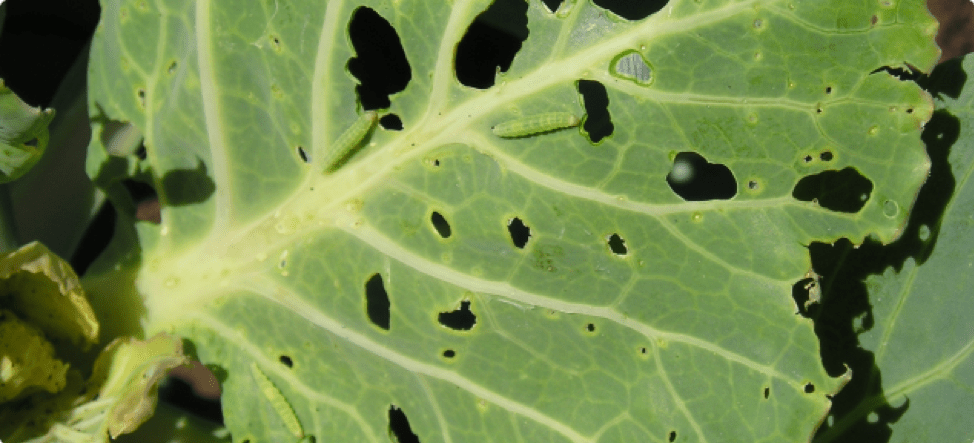
The Diamondback moth have 4 life stages, the egg, larval, pupal and adult. They attack mainly during the pupa and caterpillar stages of their life cycle. Reaching the larval stage the larvae borrow into the leaf, eating their leaf tissue, the mesophyll. With each instar stage the being to feed on the surface of the leaves, buds, flowers, and pods. When looking at produce on items such as broccoli, cabbage and cauliflower the first few stages of the caterpillars feeding cycle is spent digging deep into the head of the produce. As the diamondback moth goes through it subsequent life stages the focus shifts to the underside of the leaf and then dig even deeper. Once the moth reaches the adult stage and emerges as a fully formed moth they mostly feed on dew and water droplets, thus completely eliminating any further possible damage. When the moths are in the stages that cause the most damage it is quite obvious as the caterpillars create windows of damage that are called windows, which are often with an otherwise intact epidermis. To certain crop types they can cause severe damage / contamination on species such as; broccoli or cauliflower by pupating on it. In Canada’s vast Canola farms, the larvae stage causes the damage and will affect almost everything in the plant from the leaves to the buds, flowers, seed pods, stems and even the seeds within seed pods. They often eat everything leaving only the veins of the leaf. If given the right conditions the moth can cause millions in

economic damage to farmers. In the larva life stage they are easy to identify due to having a unique defense mechanism, which is that if the larva is disturbed it uses its silk as a rope to safely rappel off the plant. When put together the management of the Diamondback Moth is difficult to manage in its variety of stages of life. All this damage of the plant makes the early life stages of the Diamondback moth generally easy to spot, especially. As the lifecycle stages for the moth happen rapidly the evidence will appear on the crops quickly. A large healthy crop will be obvious due to the retention of its leafs until late in the season, and crops that have noticeable leaf loss then it is expected that following will be a fairly immediately and significant yield losses. Management when in season include scouting sweeps in the summer to catch an infestation before it’s too late to deal with insecticide. When scouting the crop, they often will look at the plants that are currently growing on ridges and knolls, this were the damage from this moth usually become first evident. When managing for pests it is important to keep in mind the importance of other plants and weeds to the survival of the Diamondback, because it needs to feed off something in the main crop’s off-season.

Introduced pests such as the Diamondback Moth will be an issue for the foreseeable future as they affect only food crops which have no natural defense mechanisms. Our careful management of our crops and a gradual improvement of integrated pest management efforts will be key in keeping the Diamondback population at bay for the foreseeable future and to prevent the largest peak years from occurring.

Design a site like this with WordPress.com
Get started