Written by: Alex Fleming
Edited by: Nathan Waatainen
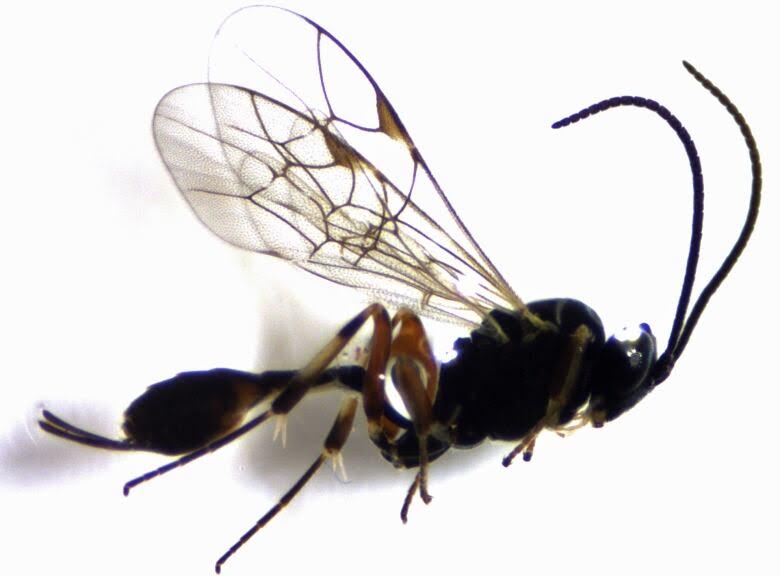
Parasitoids: The strongest natural defence mechanism (including the Diadegma Wasp) can’t keep up
Management of pest populations (such as the Diamondback Moth) requires a multifaceted approach that typically will involve introducing or promoting a natural parasitoid to attack the pest of interest. A parasitoid is an organism that survives by living in a parasitic relationship with another parasite, often times in the process killing the parasitized parasite. In healthy ecosystems parasitoids naturally exist as a type of population control mechanism, ensuring a relatively stable population of parasites. The Diadegma Wasp (Diadegma insulare) is the most effective fighter against the Diamondback Moth. While they do not kill the Diamondback Moth outright, they are still effective at protecting against the moths defoliating. The wasp can parasitize up to 90% of a generation and, while parasitized, the larvae of the Diamondback Moth only eats 20% of its usual diet. The parasitized larvae also never reach sexual maturity meaning the wasp can nullify the Diamondback Moths presence on a large scale. To do this the female lays her eggs within a larva of the moth wherein her babies will hatch and grow within the moth larvae. The wasp larvae do not kill the moth larvae, rather feeding off it slowly. The wasp larvae wait for the moth to create their cocoon and once completed, finishes feeding off its host and creates a secondary cocoon within the moths’ cocoon. A complicated but effective survival strategy.
Unfortunately our bio control efforts are being hindered due to the Diadegma Wasp being slowly pushed out of the areas where Diamondback Moth is found. As the moth feeds off our crops we fight back with our own pesticides. The moths themselves have slowly built up a resistance to many of the pesticides used, which the wasp has not been able to achieve under this time period. When a wasp reaches adulthood and gets a chance to infest a host it is generally eventually killed by the pesticide contaminating the moths’ body. Until pesticide use outdoors is reduced or the wasp species grows a tolerance to the pesticide there will be ongoing issues related to biocontrol implementation.
A potentially important parasitoid species that is also being damaged by insecticides is Oomyzus sokolowskii. This Diamondback Moth killing species was found to suffer a 91% mortality rate when exposed to cabbage leaf which was dipped in insecticide in a study conducted in the South-Eastern United States by Roberto J.Cordero, Jeffrey R.Bloomquist, and Thomas P.Kuhar for Biological Control Vol. 42. This study’s result indicates that if we hope to manage the DBM effectively we must consider the consequences of trying to use two different pest control methodologies simultaneously.
Predators: The ‘second ringers’ are now our first defence
The Diamondback Moth has many other predators, although none of them hunt the moth with the same drive and need as the Diadegma Wasp. This moth native to Europe, but found in many other continents is able to lay hundreds of eggs in its 25 day life span. One weakness of this wasp is that they do not hunt for the fully-developed moths, instead subsisting on moth eggs and larvae. It’s not fully understood how effective these predators are at fighting back against the Diamondback Moth from a management standpoint, but it is estimated that they regularly kill 90% of the first instar larvae.

To better understand the wasp’s effect on the moths’ population, a study was done by Freddy Miranda and colleagues for the 40th edition of Environmental Entomology. This study was conducted within several cabbage fields in Nicaragua for the purpose of trying to identify the most common and most effective predators to the Diamondback Moth found locally. The full list of species as follows was divided between the classification of spiders and insects:
| Spider | Insect |
| Sac Spiders (Clubionidae) | Rove Beetles (Staphylinidae) |
| Ground Spiders (Gnaphosidae) | Earwigs (Forficulidae) |
| Wolf Spiders (Lycosidae) | Hover Flies (Syrphidae) |
| Sheet Weavers (Linyphiidae) | Toad Bugs (Gelastocoridae) |
| Jumping Spiders (Salticidae) | Damsel Bugs (Nabidae) |
| Long-jawed Orb Weavers (Tetragnathidae) | Assassin Bugs (Reduviidae) |
| Crab Spiders (Thomisidae) | Eusocial Wasps (Vespidae) |
| Harvestmen (Phalangiidae) |
Of these candidates the most common species from each list was the Wolf Spider, making up 37% of all spiders found, and the Rove Beetle at 54% of all insects collected. Once this information was drawn, several tests were undertaken to find out which of these species were the most significant eaters of the Diamondback Moths eggs and larvae.
Each species was trapped and secluded before being starved for 24hrs as a measure to ensure that a uniform hunger would be accounted for. Next they were offered eggs, as well second and third instars of the moth and were fed for up to 13 days or until the predator died. Of the species found eating eggs, no spiders were recorded, however, there were two clear successors among the insects: Rove Beetles and Damsel Bugs. The second and third instar larvae were primarily consumed by the spiders. The study found the most successful of the spiders were: Sheet Weavers, Wolf Spiders, Jumping Spiders, Crab Spiders, and Long-Jaw Orb Weavers. The larvae inclined insects were: Rove Beetles, Hover Flies, Damsel Bugs, and Assassin Bugs.
While more tests are required before anything definitive can be said of the efficacy of using parasitoids of the Diamondback Moth in agriculture on an industrial scale, the early reports show that there is hope. Researchers now have a narrower scope of insects and spiders that should be investigated. Parasitoids may likely soon be very helpful on an industrial scale in fighting back against the moths’ destruction of our cruciferous crops worldwide.
Parasitoids: Are they a realistic consideration in DBM management?
Utilizing parasitoids in management of pests on food crops is typically very difficult, largely due to continuous need for improvements, research and monitoring. While there are parasitoids which have worked to keep the Diamondback Moth populations in check in the past, most are no longer effective. Many have become next to useless when it comes to the Diamondback Moth management due to natural adaptation because of past usage as an active ingredient in pesticides. As the moth has developed a greater resistance to the pesticides used on fields everywhere it has also overcome the effects of most pathogens that target insects.
It’s important to note that there are three possible exceptions to this pattern: Bassi (Beauveria bassiana), Mechinikov (Metarhizium anisopliae), and Wize (Paecilomyces fumosoroseus) which are all funguses that have proven to be effective against the Diamondback Moth. There is still not enough research data to justify their use in any large-scale capacity either but they have quickly become the next major research and development focus.
Nature has been an effective manager of the Diamondback Moth population in the past. Without an exterior influence it is likely that this statement could apply for today and in the future.

Diamondback Moth caterpillar encased in Bassi Fungi
Sources:
https://academic.oup.com/ee/article/40/2/333/412166
https://www.sciencedirect.com/science/article/abs/pii/S1049964407000904
https://www.pestnet.org/fact_sheets/biocontrols__diadegma_285.htm
https://www.shutterstock.com/image-photo/infection-beauveria-bassiana-insects-zombie-on-169231043

