Written By: Joseph Manes
Editor: Kim White
The diamondback moth goes through complete metamorphosis, meaning they have distinct egg, larval, pupal and adult life stages. This complete cycle from egg to adult varies and through each stage is dependent on the temperature. The average development time is between 21 – 51 days with the warmer southern parts where diamondback moths are found being quicker than the colder northern parts. With the cold weather found in northern climates the mortality of the diamondback moth is quite high, curtailing the population. Throughout the year the diamondback moth goes through four to five generations of which generally overlap between the generations. Due to this each stage of the life cycle, from egg to adult can be found simultaneously. During mating season, the female can lay between 200 – 300 eggs, with an average of about 150 in their life span of about 16 days. The laying of the eggs can be quite quick when given a readily available host. As larvae they have a distinct reaction to being disturbed, they wiggle backwards and drop from the plant, dangling by a silk thread, of which after several seconds they will climb back on top of the leaf to continue eating.
Egg: The eggs of the diamondback moth are mostly laid on concavities of the leaves avoiding the smooth surfaces. These eggs are glued to the upper and lower parts of the hosts leaves with the underside being preferable due to the protection from direct sunlight. Eggs are oval in shape, tiny, and have a yellowish-white color to them. Depending on the environmental conditions present the eggs take anywhere from four to eight days to hatch into the subsequent larval stage.
Larvae: Once the eggs have hatched into larvae they begin to immediately burrow into the leaf, eating the host plants leaf tissue, the mesophyll. The larvae will molt three times, with these subsequent instar stages feeding on the surface of the leaves, buds, flowers and pods. This stage can last between ten to 21 days, with this varying depending upon the given temperature and food availability. These larvae are yellowish green to green which are covered with fine, scattered hairs and have a forked end. At maturity these larvae measure in at about 12mm and are cigar in shape. After the last instar stage, the larvae begin to construct a cocoon to begin the pupal stage.
Pupal: The cocoons that were made at the end of the pupal stage are attached to the leaves, stems or seed pods of the host plant. They are white open meshed, and delicate, with development being finished between five to 15 days. As the pupal develops the turn from a light green to a brown as they mature into the adult moth.
Adult: The moth that emerges from the pupal stage is about 8 to 9mm long and has a wingspan of about 12 to 15mm. Their wings fold over the abdomen, flared upward and outward toward fringed, long haired tips. Yellow wavy markings on the forewings at rest come together to form three diamonds, giving the moth its name. These are short lived and typically feed on dew and water droplets, finishing off the life cycle.
Overwintering and effects of climate change: Temperature is a major factor in the success of diamondback moths. Development of instars occur more slowly at when temperatures are lower (between 4-6 degrees Celsius). Survivorship decreases significantly at 0 degrees Celsius. The fourth instar has proven to be the most successful during cold conditions out of all the instars.
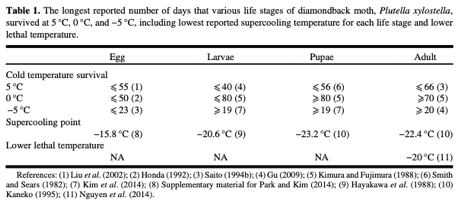
There is some discrepancy about when or if overwintering occurs. Historically, it was thought to occur during the pupal stage. A study done by Harcourt and Butts found that pupae survived for 30 days with temperatures around 0 degrees which followed by health adults emerging. However, after 40 days, the adults that emerged died shortly after. It has also been proposed that overwintering occurs in the adult stage and there was more survival at temperatures around -5 degrees Celsius. Diamondback moths do not overwinter in diapause but rather they survive unfavorable conditions in quiescence. It is more common that diamondback moths travel North from warmer, more southern regions when temperatures are more favorable and there is an increase in food sources.
Climate is changing and with that comes the concern of increased pests in crops. Diamondback moths do not do well when it is very cold but have been able to survive mild winters. With climate changing and temperatures rising, this could become a concern. However, at this point in time, it does not seem to be a significant issue because where these crops are, winters still get cold enough for long enough to keep the moths at bay. Furthermore, there needs to be more research and studies done to know exactly if or how the diamondback moth will progress as the climate continues to change.
 classicdiamondback.school.blog