Written by: Kim White
Edited by: Alex Fleming
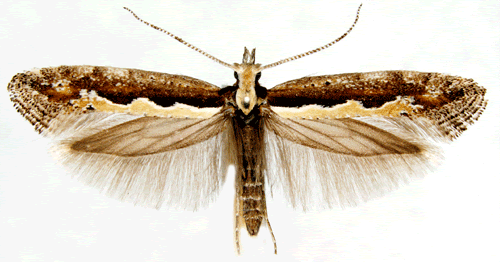
Diamondback moths can cause millions of dollars in damage if left unmanaged. In Canada, the diamondback moth affects crops in Eastern Alberta, Saskatchewan and Manitoba. The moths arrive from the South by wind in May and can survive up until the cold prairie winters. Managing for diamondback moths is necessary to prevent serious damage to crops and limit the impact on the economy. The severity of impact varies year to year however, with management we can reduce the risk.
Monitoring for diamondback moths is the first and most critical management tactic. Understanding the approximate population at the beginning of the season can help with determining how the pest needs to be further managed. Fortunately, there are some biological management tactics that have been discussed and can be just what is needed. However, if the pest becomes more severe then further action must be taken by using insecticides. Insecticides can be applied with either aerial or ground equipment. The application of the insecticide is most effective when populations are at their larval stages. Effectiveness is reduced for adults, pupae and eggs. Insecticides can kill adult diamondback moths however, because they lay eggs within 24 hours of becoming an adult, this would have little effect on controlling the pest.
The table below lists the products that can be applied to control the diamondback population. It is important to take note of the pre-harvest interval (PHI) because it varies with each product and it is illegal to harvest before the PHI. The following table is a list that the Government of Manitoba provides of the insecticides used for diamondback moths, the pre-harvest intervals and the amount needed per acre. Applying insecticides on flowering crops is not recommended due to the risk of harming honeybees and other pollinating insects. Therefore, if insecticide must be applied to flowering crops, it should be done in the evening.
| Product | Rate of product per acre | Preharvest Intervals (days) | |
| Canola | Mustard | ||
| Coragen | 51 ml | 1 | 1 |
| Decis 5EC | 40-60 ml | 7 | 7 |
| Poleci | 81-121 ml | 7 | 7 |
| Matador/Silencer | 34 ml | 7 | 7 |
| Voliam Xpress | 91 ml | 7 | 7 |
| Lorsban/Pyrinex/Nufos/ Citadel | 405-607 ml | 21 | — |
| Malathion 500 | 220-340 ml | 7 | — |
| Malathion 85E | 105-168 ml | 7 | 7 |
Table 1 https://www.gov.mb.ca/agriculture/crops/insects/diamondback-moth.html
Chemical reliance for controlling diamondback moth populations has resulted in the pest developing a resistance to some insecticides. In Australia, there has been evidence of resistance to synthetic pyrethroid insecticides which adds to the challenges of controlling diamondback moths.
Another method is adjusting the amount of fertilizer in the soil. The diamondback moth prefers the amount that is recommended for the crops, however, studies have shown that either not using fertilizer or using 3-5 times the proper amount is beneficial for management. Sulfur-fertilizer seems to have the greatest influence on the diamondback moth, females tend to lay their eggs where there is a higher sulfur content compared to soil that is sulfur deficient.
Some other methods of management are starting crops with clean and healthy transplants, checking brassica crops weekly during the summer months, plough crop residues or heavily infested crops promptly, and understanding the life cycle of the moth and recognizing the larval stage. Pre-seeding weed control and preparing the land reduces the availability of cruciferous weeds and volunteer canola host plants, preventing the first generation of larvae to be established.
One option that is still being tested is the use of synthetic sex pheromones. They are used as a mating disruption and so far have proven to be effective when mixed with other, more traditional control methods. The greatest benefits of using this method is the reduction to Diamondback Moth populations without affecting the populations of predators and parasitoids. Two studies, one done in Japan in 1986 and the other in China in 2008-09 have proven it’s effectiveness. In both cases there were three groups of fields: one control, one using traditional pesticides, and one using pesticide and mating disruption.
The control group was so badly damaged that no numbers could be recorded of adult males or of the eggs and larvae that settled there. As for the other fields, adult males were shown to remain at roughly the same density between both the insecticide field and the insecticide+pheromone field. The fields using pheromones did have less adult males overall but the difference was to small to be considered significant for the case of the study.
However the number on eggs and larva found on the plants did change significantly with the use of pheromones. In the Japanese study there were 3 or more larvae/pupae found per plant after a month of observation. In comparison, the fields sprayed with the insecticide+pheromone mixture had an average of 2 per plant recorded in one month before showing signs of declining.
When the study was done in China there were other factors being tested for, namely the amount of dispensers used per hectare and which had the greater impact. It was found that too much of the pheromone was counter productive, having little to no impact. The greatest effect on the Diamondback Moth was when using 167 polyethylene ‘rope’ dispensers per hectare. This produced very similar results to the study conducted in Japan, further proving the strength of using pheromones as a control measure. These studies show that pheromones can reduce populations by up to 50% when compared to traditional-practices.
This method does have it’s own drawbacks and still requires testing to see just how effective it is. Setting up a large number of dispensers, or spraying multiple times, gets expensive. While less sprays are required before seeing significant changes to the Diamondback Moth populations it does nothing to prevent other pests from coming in and devouring the same plants that we are trying to protect. There is also a chance that, due to the nature of studies done so far, not all of the success can be given to the use of pheromones alone. In both cases there were predators and parasitoids found within the fields that could have contributed to the reduced populations and neither study had any way of accounting for their presence.
Diamondback moths have the potential to cause a lot of damage. Fortunately there are options to manage for the pest and if there is consistent monitoring and management, the risk of damaged crops is largely reduced.
Resources:
https://www.gov.mb.ca/agriculture/crops/insects/diamondback-moth.html
https://onlinelibrary.wiley.com/doi/full/10.1111/j.1744-7917.2011.01497.x
 classicdiamondback.school.blog